
Let’s start with a basic overview of what Bitcoin is, then look deeper into other aspects of the coin.
Bitcoin Basics
Bitcoin is the first-ever cryptocurrency ever created. It is a digital currency that operates free of any central control or third-party involvement from a government or central bank. This is the main benefit of Bitcoin.
Read the Bitcoin white paper to see how Satoshi Nakamoto first described Bitcoin.
Bitcoin is viewed as potentially undermining the current centralized institutions that currently run the financial world. Bitcoin relies on peer-to-peer software, cryptography, the blockchain, proof of work, and mining.
The beauty of Bitcoin is how there is a public ledger of all bitcoin transactions which are hosted on servers across the globe. Just about anyone with a PC can set up one of these servers (or nodes). Consensus on who owns what and where Bitcoin goes is verified cryptographically between these nodes dotted around the globe. Again, this eliminates the need for a centralized institution to track and provide a consensus as to what is happening.
Each and every transaction is shared with the network and shared between the nodes. The transactions are then collated together by miners into groups called a block and stored permanently on the blockchain. This is essentially the record book of Bitcoin. Completely verifiable, decentralized, and uncorrupted by that of a biased institution.
Much like you would hold fiat currency in a physical wallet, digital assets like bitcoin are held in digital wallets. These digital wallets can be accessed via client software and hardware tools like non-custodial cold wallets.
Interestingly, a Bitcoin does not exist like we know a table or a chair to exist. Bitcoin exists due to the agreement among the network created about the ownership of the coin. Holders of bitcoin use a private key to prove ownership of their funds to the network when transacting with other users on the blockchain. Users can simply write their private key or memorize their private key and only require this to access their funds.
Can Bitcoin Be Used Like Cash?
Bitcoin is a store of value and can be converted to fiat currencies pretty rapidly. After all, it is simply a digital asset with a value attached to it. To convert bitcoin into cash, one must trade it with another user for cash or use a decentralized or centralized exchange to trade bitcoin for cash. Similarly, one can pay for goods and services with bitcoin as if it were cash should the merchant accept bitcoin. Even whole countries are legitimizing bitcoin as a store of value or currency to use (E.g. El Salvador recently made bitcoin their national currency).
There is nothing necessarily to back the value of bitcoin. The value is simply deemed by the price people are willing to pay for it. However, this is not a drawback as the same can be said for the likes of the US Dollar or the Indian Rupee. Value is simply agreed upon by the users, especially since currencies are no longer backed by the gold standard.
Why Was Bitcoin Created?
Bitcoin was made to allow people to send money across the internet. It was created for the reasons it exists today: sending money without a central authority over watching it. Many people have used Bitcoin for illegal activities, but it has also been used for great causes too. It’s extremely difficult for the layman to transfer millions of dollars worth of value through a bank or any other centralized system. There is a lot of bureaucracy in the way. However, with bitcoin, users can send vast amounts of money quickly, with very little transaction fees. Bitcoin is doing as it is meant to so far!
Now Bitcoin’s value is looking to be largely centered around the “store of value” narrative. Bitcoin acts as “digital gold” or “digital property”, that stores value and becomes scarce over time, much like gold.
Is Bitcoin Safe?
Cracking the bitcoin network is near impossible. There are more private keys that would need to be hacked than there are atoms in the universe. Mind-boggling when you think about it, but this is the power of bitcoin. Safety is built into its very nature.
However, obviously, not every single thing about bitcoin is safe. Yes, it is safe in and of itself, but this doesn’t mean that daily hacks, scams, and other nefarious activities aren’t taking place. Exchanges are constant targets of attack as millions if not billions of dollars in value are being stored. It is the exchange or website being hacked, not bitcoin itself.
One potential problem users will encounter is losing their bitcoin themselves. As there is no centralized authority looking over your bitcoins, you can lose them if you misplace them. If you misplace cash with a bank or get scammed, there is usually some rest bite and compensation. For example, if you lost your private key, or sent your bitcoin to the wrong address, there is nobody who can help you, generally speaking.
A looming problem is quantum computing. The bitcoin network exists through mathematical calculations which cannot be cracked by modern computers. However, quantum computers are likely to be able to hack into the like of bitcoin in seconds. Thankfully, as this moment approaches, everyone should be aware of it. Our computing power is not particularly close to this currently.
Explain More About Bitcoin Mining
Sure! Mining is the way that a new bitcoin is created. It cannot be created any way other than through mining.
Bitcoin transactions are publicly broadcast on the bitcoin network and miners group selections of transactions together into “blocks” by finalising a cryptographic calculation. This calculation is incredibly hard to generate – but very easy to verify transactions. The first miner to solve the next block broadcasts it to the network and when proven correct – it is added to the blockchain. The miner then earns an amount of newly generated (or mined) bitcoin.
Bitcoin mining has massively changed as the years have gone by. Initially, one could use a very basic computer to mine bitcoin. Now you must have a very advanced setup to compete in the bitcoin mine sphere.
Competitors have warehouses full of expensive equipment, and high-end software to crunch through the mining calculations. What was once an extremely profitable venture is now highly complex and hard to be profitable with. Only seasoned vets are making money in this space and the layman cannot easily enter the space. Not anymore.
Who Invented Bitcoin?
Satoshi Nakamoto, an anonymous figure created Bitcoin in 2009. He started by publishing “Bitcoin: a peer-to-peer electronic cash system” on his website in 2008. He detailed the theory and thought process behind the system. He wanted to create a digital currency free of centralized control.
Notably, he wrote about how trust was an extremely important factor when it comes to currencies. Yet, this trust has historically always been breached by governments and central banks. Specifically, governments have also debased currencies, making them less and less valuable. This is OK for the wealthy as they own valuable assets, but not conducive to the poor who rely on currency to survive and usually own no assets.
Nakamoto continued to develop Bitcoin until 2010 when Nakamoto dropped out of the project. To this day, there is no public record of who Satoshi Nakamoto, bitcoin’s creator, is.
Bitcoin is now an open-source software, meaning anyone can view or work on the code openly. Lots of prominent companies are working to improve the software. Note, that this does not mean Bitcoin is centralized!
Are There Any Problems With Bitcoin?
No! Bitcoin is perfect. Just kidding. But Michael Saylor might say that…
Well, one criticism is that the mining system requires a lot of energy. For example, it was predicted bitcoin uses around 100 terawatt-hours per year. In comparison, the UK used 304 terawatt-hours in 2016, which shows how much energy is used.
However, the same could be said about the energy consumption banks use around the world. Between the paperwork, staff, transport, electricity, etc. – this is certainly a vast use of the world’s resources, too. Perhaps not as much as bitcoin mining itself, but certainly a lot. Another thing to consider is that bitcoin mining will one day cease to exist.
Another problem with bitcoin is criminal activity. Money laundering. Criminals are highly incentivized to send bitcoins as their currency of choice. There’s no payment processor, traditional currencies, banks, or governments to worry about.
Many criminals are using bitcoin to make illegal transactions between borders. In any case, criminal activity will always exist and criminals will find a way to send bitcoin or any other type of money or virtual currencies. Cash was used before the advent of crypto. In any case, bitcoin could be a solution to criminal activity, considering all transactions are publicly viewable. As we see more adoption and regulation of bitcoin, we expect to see tighter rules and less criminal activity surrounding the entire space. For now, it still feels like the Wild West!
Bitcoin’s Price
Bitcoin started completely valueless when it was mined into existence. The price was $0.00! Now the price of one bitcoin is in the tens of thousands of dollars. The market capitalization has been above and below a trillion dollars over the last couple of years. Those who were smart enough to hold bitcoin from the start have made a fortune.
We expect the price to keep rising as conventional currencies face inflation and other nefarious intervention from centralized entities. Traditional currency seems to be facing major issues in 2022, but cryptocurrencies are becoming more widely used around the world.
Another aspect of Bitcoin is how it is deflationary. Eventually, there will be a finite amount of bitcoin left in circulation. No new bitcoins will come into circulation and nothing makes bitcoin-only mining. Once the mining is complete, bitcoin then truly becomes a finite asset. We are looking at 2140 before there are 0 remaining block rewards to be earned for miners.
How Do I Get Bitcoin?
You have a few options to get hold of some bitcoin.
As discussed, mining bitcoin is one way – but that is costly.
Your best bet is to buy bitcoin. You can do this by simply buying from one of many crypto exchanges, such as Binance or Coinbase. You’ll need to create an account there, add fiat currency, and then exchange your fiat currency for bitcoin.
Cryptocurrency exchanges are plentiful. You simply need to select the most appropriate exchange based on the country you reside in and your needs.
Another option is a peer to peer. Create a wallet, for example, you could use MetaMask, and have a friend send you Bitcoin. Some cryptocurrency exchanges allow you to use their peer-to-peer system whereby they act as the escrow for your transaction.
After making your bitcoin purchase, you should carefully store it on an exchange or in your own wallet. If you use your own wallet, make sure to never lose your private keys, as you will lose your bitcoin!
The Future of Bitcoin
Entire nation-states are now introducing bitcoin as their currency, like El Salvador. Slowly but surely, the whole world is waking up to bitcoin and how it could be a legitimate currency or store of value to replace gold.
America even looks to be introducing a bitcoin ETF which is a huge step in the right direction for bitcoin. This legitimizes it in the face of the average person who is not particularly tech-savvy. If the governments and banks are OK with it, then it mustn’t be a scam like we once thought! Ha. We expect the price to continue to soar in an upwards direction as even more mass adoption kicks in. Yes, there will be bumps in the road as with all markets, but overall, we predict that bitcoin will continue to rise in value.
Bitcoin does face scalability issues, meaning it is hard to build on. Other coins like Eth of Ethereum are doing a better job at creating the framework for decentralized applications to build on. For now, bitcoin has the “digital gold” crown – but can it branch out and be used for more than just this? We shall see how the developers and community wish to push forward with Bitcoin.
Bitcoin vs Ethereum
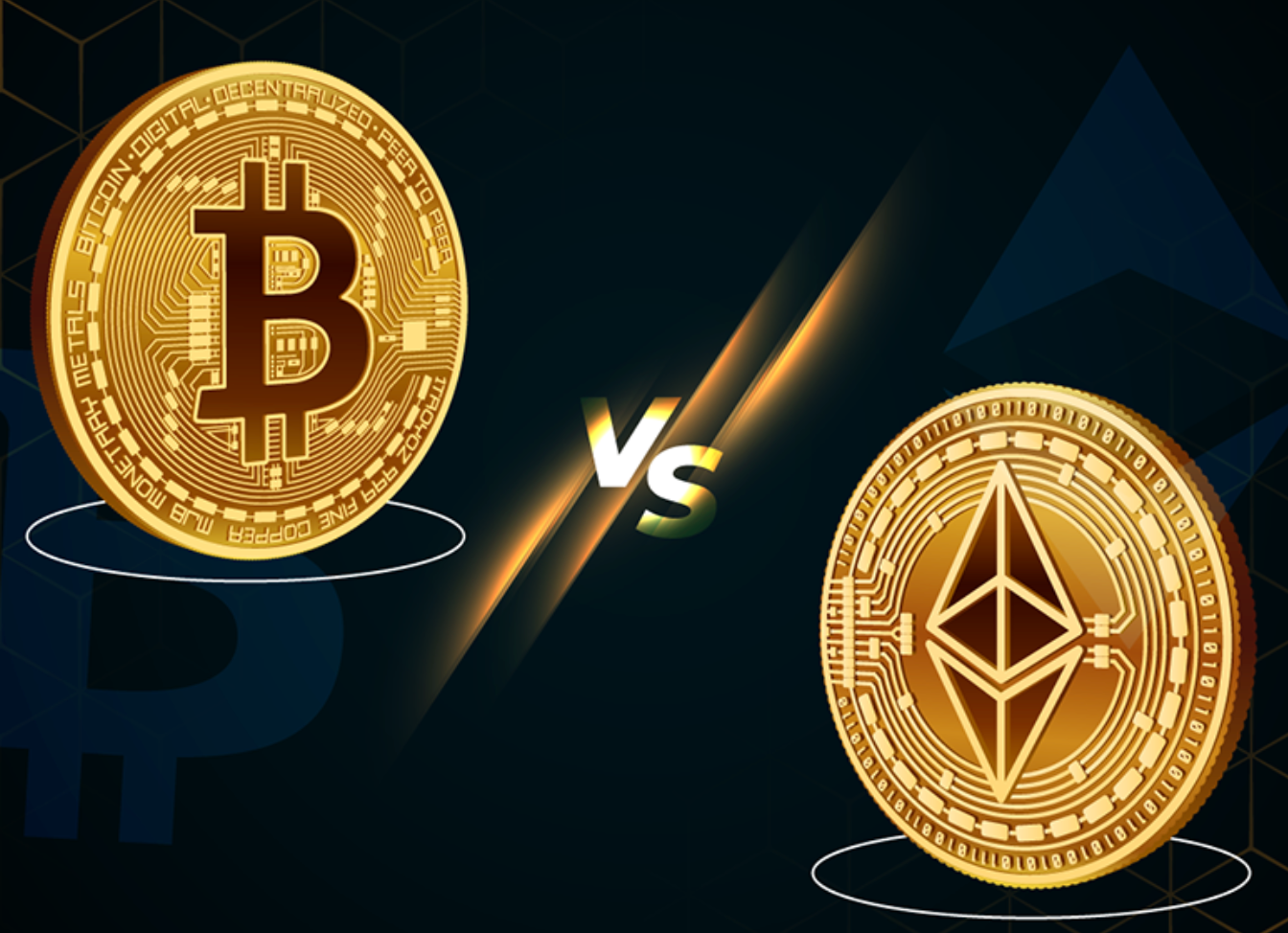
Some investors favor Bitcoin over Ethereum and vice versa. Bitcoin and Ethereum are the two largest cryptocurrencies, and both have major benefits, as well as some downsides.
For example, Ethereum Maxis will say that Bitcoin Maxis are too stuck in their ways or too tribalistic about Bitcoin. Especially seeing as the Bitcoin network has been taken over by the likes of Ethereum and other competitors.
Bitcoin Maxis would say Ethereum is replaceable, as it is simply somewhere to build smart contracts, and other chains will allow you to do this.
Both sides have a point. Yes, Bitcoin and Ethereum have weaknesses. However, they have proven to be the two strongest cryptocurrencies by a long shot.
It’s our belief that both coins are worth holding, and one shouldn’t own one in spite of owning the other. One should appreciate the benefits of Bitcoin AND Ethereum!
Ethereum looks to be creating the main place for decentralized app creation, whereas Bitcoin has secured the crown for digital gold. But with Ethereum’s agile and aggressive expansion style – who knows, maybe they will have something to say about that crown themselves.
Anyway, that concludes our “what is bitcoin” post and we hope you do indeed have a better understanding of what is bitcoin exactly!

